The Role of the Mid-America Regional Council
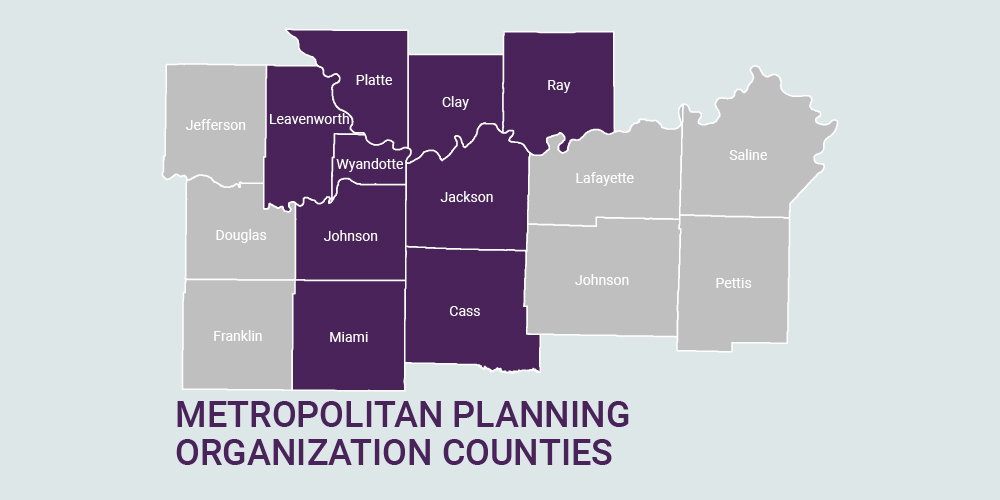
The Mid-America Regional Council (MARC) is designated by the federal government as the Metropolitan Planning Organization (MPO) for the bistate Kansas City region. Our MPO boundary includes Cass, Clay, Jackson, Platte and Ray counties along with a small portion of Lafayette County in Missouri, and Johnson, Leavenworth, Miami and Wyandotte counties in Kansas.
As the MPO, we are responsible for coordinating transportation planning activities to keep people and goods moving along our roads and interstates, on buses and the KC Streetcar, and on trails and bikeways within our region.
We partner with federal, state and local agencies, transit providers, stakeholders and the public to develop plans and projects that enhance quality of life throughout the region. Guided by our vision that Greater Kansas City is a region of opportunity, we work to support a strong economy, healthy environment and vibrant communities for all.
Because our work extends beyond transportation, we take an integrated approach that considers transportation, climate resilience, water and air quality, housing, aging and adult services, workforce development and early learning. Ongoing collaboration with communities, elected officials, advocates, subject matter experts and local leaders is the foundation of this comprehensive planning process.
We are committed to a public participation process that:
- Involves the public in decisions that affect their lives
- Ensures public input is considered in the planning and decision-making process
- Communicates how the public's contribution will influence decisions
- Is adaptable and sensitive to diverse audiences
- Promotes respect
- Provides access to opportunities, information and education for all residents
- Ensures timely response to participants
- Is consistent and reliable
- Builds relationships and promotes continued engagement
- Allows for flexibility and use of creative and innovative approaches
- Maintains honesty and integrity throughout the process
- Continuously strives to educate and inform affected and interested parties to give them a more meaningful participatory experience
- Encourages early and active participation
Planning Process
The development of this plan is driven by feedback and input from staff performing engagement, partner agencies and the public. MARC aims to have an engagement process that builds relationships with the community and is continually improving to address community needs in both proactive and reactive ways.
MARC developed this plan through a collaborative and inclusive engagement process. The process begin with internal workshops involving MARC staff to identify key principles of community engagement and establish successful strategies. MARC then engaged partner agencies and advisory transportation committees to gather expertise and external feedback to help refine the goals and strategies included in this plan.
MARC conducted a public survey to collect input from residents and stakeholders throughout the region. This survey was focused on how residents prefer to be engaged in region planning processes. Survey results, along with feedback received through internal and partner engagement activities, were used to inform planning decisions, identify community needs, and guide the development of final recommendations in this plan. Full survey results can be found in Appendix X.