Streetcar doubles pace of new construction permits

Feb 24, 2026
| Posted in
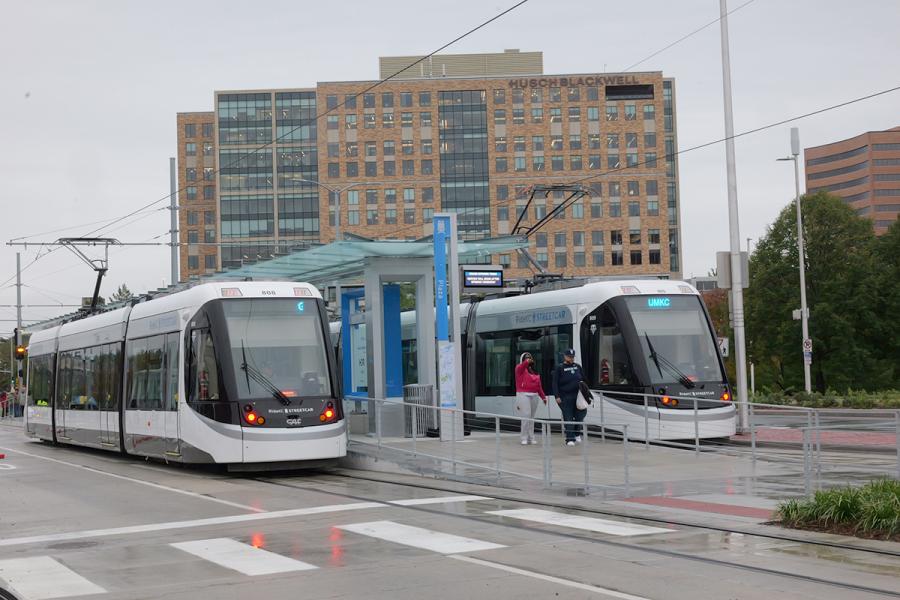
KC Streetcar station stop

The Kansas City Streetcar runs 5.7 miles along a single corridor — Main Street from the City Market to UMKC. Along both the starter route from the City Market to Union Station and the extension to UMKC, the pace of new construction roughly doubled following transit investment. What got built, however, depended largely on existing land use and the development market already in place.

Both the starter route and extension segments share similar zoning and incentive policies, yet development reinforced neighborhood character rather than reshaping it. Downtown remained largely commercial and dense, while the extension remained primarily residential.

For communities weighing transit investments, understanding what a corridor already supports can matter as much as the investment itself.

What the data shows

To measure development activity, we examined new construction permits from Kansas City’s Open Data KC portal to track project-level development across both segments of the streetcar. Permits were classified as residential (single-family, duplex, multifamily) or nonresidential (commercial, civic, industrial).

The chart below tracks annual permit activity from 2010 through 2025, marking key milestones in the streetcar's development.

Permit activity picked up quickly after the downtown Transportation Development District (TDD), a separate and specialized taxing district established to fund, build and maintain public transportation infrastructure, was established for the starter route. Permits jumped from four in 2013 to 20 in 2015. The extension saw an even bigger response, with 35 permits in 2019 — the highest single year in the dataset.

To smooth year-to-year swings in the data, annual permits were averaged before and after the establishment and expansion of the TDD. For the starter route, the pre-TDD includes only 2010 and 2011, since earlier years were distorted by the Great Recession. For the extension, the pre-TDD period spans 2010 to 2016.

In both segments, new construction projects roughly doubled after TDD designation, increasing from an average of three to six per year for the starter route and from five to 11 along the extension.

One route, two patterns: How the streetcar reinforced corridor character

While the pace of development increased alongside both segments, what got built differed significantly.

The starter route, located in employment-rich downtown, drew permits focused on commercial activity and high-density, multifamily housing. The extension, running through a more residential corridor, produced a balanced mix that closely resembled development patterns throughout Kansas City during the same period. 

These differences mirror the pre-existing development mix in each corridor segment. Nearly 70% of starter route permits were for commercial and high-density multifamily construction. The extension was more evenly split across permit types, with a significant amount (37%) of single-family housing.

Timelines also shape what's feasible to build. The starter route moved from announcement to operation in four years, shortening the development window and attracting large, capital-intensive projects. The extension took eight years, marked by funding delays and extended construction that spread activity over time and lowered barriers for smaller residential projects. In both cases, prior development on Main Street had already begun to prime the market.

What this means for the region

The fixed-route streetcar is an outlier within the region, benefiting from pre-existing density, walkability and access to transit not shared by many other corridors.

Its value here is to showcase that transit doesn’t create development out of thin air, it amplifies the existing nature of what’s already there. For regional frameworks like Smart Moves, these findings highlight the importance of corridor context. Baseline land use, market conditions and existing policy may matter as much as the investment itself in shaping what growth follows.

Methodology and Limitations

Permits within a half mile of the streetcar corridor were analyzed and classified as residential or nonresidential. Each permit represents one project by unique identification number (PIN). Permits without valid addresses were dropped, and where multiple permits shared a PIN, the most recent record was kept.

This analysis compares the timing and composition of permitting activity as a signal of developer intent. Permits are an indicator of expected construction but do not guarantee that construction will take place as planned. The data used counts projects, not units or construction value, which can underrepresent larger multi-unit developments where a single permit may represent many units. 

Image courtesy buildkcstreetcar.com.