Kansas City metro’s 2026 economic outlook

Dec 04, 2025
| Posted in
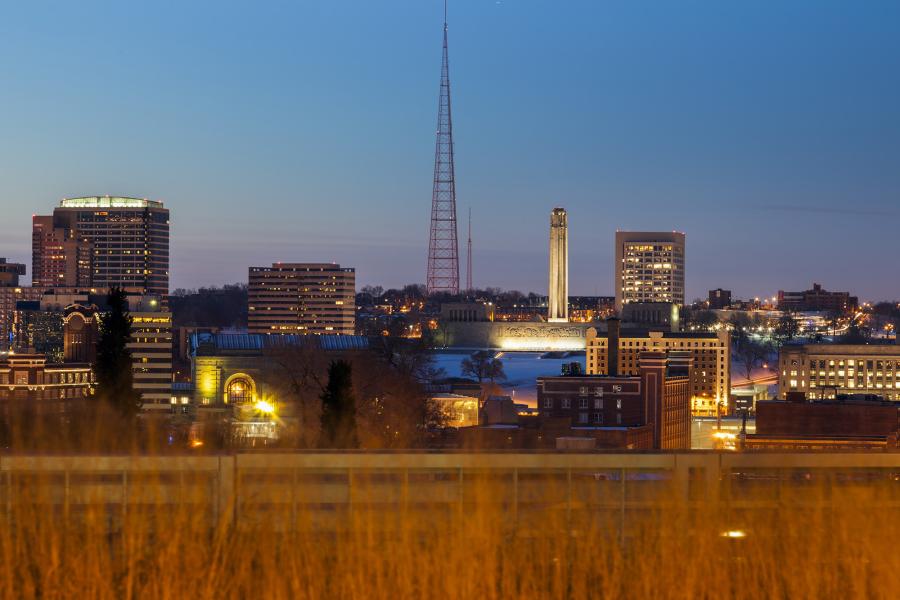
A view of downtown Kansas City at dusk with brown native grass in the foreground

This forecast was developed by Frank Lenk, director of MARC’s Office of Economic Research, for the Economic Outlook Conference, held by the Federal Reserve Bank of Kansas City and MARC on Nov. 6.

Key trends

Employment and growth

The region’s employment has been flat for the past 18 months, causing the unemployment rate to rise to 4%. The area’s reputation for stability means it avoids deep downturns but also misses out on periods of rapid growth. As a result, the region’s job recovery from the COVID-19 recession lags behind the U.S. by about four percentage points.

Sector performance

Service-producing industries — especially professional, scientific and technical services — are underperforming, largely due to changes like Cerner’s acquisition by Oracle. Insurance and management sectors also trail national trends. In contrast, goods-producing sectors such as manufacturing (boosted by firms such as Garmin, Honeywell and Panasonic, as well as pharmaceuticals), construction are outperforming the nation. 

Federal workforce

A recent wave of deferred resignations among federal workers is expected to cause a short-term dip in employment in the fourth quarter of 2025, pushing 2025’s job growth into negative territory. Recovery is projected to begin in 2026 and accelerate by 2027. 

Strategic priorities

Broader economic base

The loss of Cerner as a regional economic engine is reminiscent of the decline of Sprint in the 2000s, which is when the region started growing slower than the nation. The region’s dependence on a few major employers highlights the need for a more varied economic base. At the Economic Outlook Conference, leaders urged the region to build a better bench of growing sectors, focusing on bioscience and health, national security and energy.  

These sectors were chosen as part of the KC Investment Playbook, developed by the Civic Council of Greater Kansas City and Kauffman Foundation. These sectors both build on the region’s existing strengths and have sufficient growth potential to power the region’s economy into the future.

Emerging opportunities

The Kansas City region is well-positioned for growth in data centers, critical minerals processing, battery manufacturing and biosciences. Regional assets like the National Bio Agro-Defense Facility and pharmaceutical development capabilities offer competitive advantages.

Bottom line

The Kansas City metro economy is steady but needs renewed momentum. By embracing different sectors, investing in emerging fields and fostering a culture of innovation, the region can position itself for stronger growth and resilience in the years ahead.