Local innovators explore how prefab and modular construction can increase quality housing across the region 

Aug 13, 2026
| Posted in
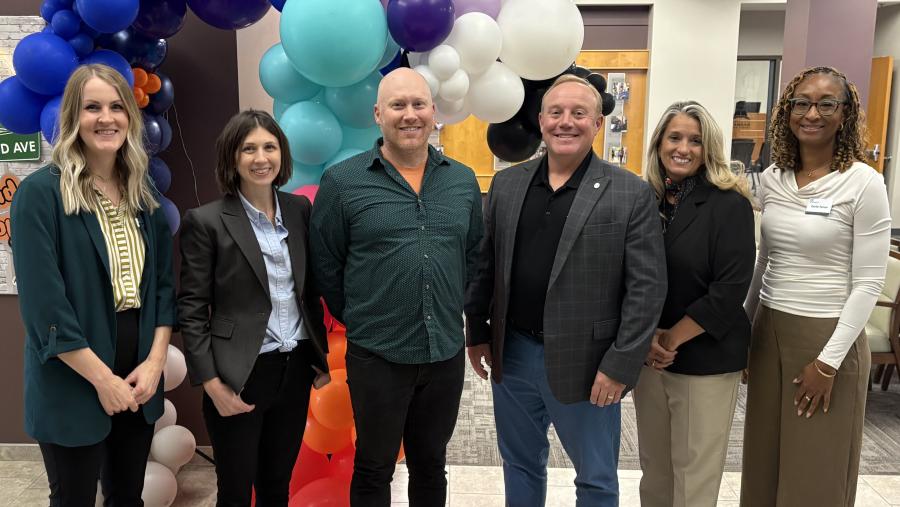
Panelists in a row, smiling, in front of balloons.

On May 20, 2026, MARC Regional Housing Program Manager Hannah Mitchell opened the second Housing Policy Innovation Series event with a guiding question for the audience and presenters. 

“How can local policies and processes better support prefab and modular construction?” 

Community leaders from across the region answered by showing how they’ve used prefab and modular housing in their own work. 

Two of the presenters, Michael Gibson and Doug Cowan, focused on prefab building materials in housing construction. 

Gibson described what is needed to approach prefab through housing policy—high-performing, affordable, systems-based building.

Michael Gibson, professor of architecture at Kansas State University.

He then shared how he applies systems-based building through the Net Positive Studio, a service-learning course he leads focused on researching, designing and building affordable, net zero housing prototypes with non-profit partners. The Net Positive Studio uses prefab microfactories, prefab panels and prefab modules in their residential construction, resulting in the construction of more than 30 homes and an additional 12 prototype homes with nine partners.

Later this summer, Gibson is publishing a Better Housing Toolkit, focusing on best practices and opportunities for innovation in neighborhood planning and construction.

Cowan talked about how CSL's Affordable Homes initiative engages high school construction trade students from the Independence School District in constructing single family homes from the ground up, providing the students with real-life construction skills and the opportunity to have a positive, direct impact on their communities.  

Doug Cowan, president and CEO of Community Services League (CSL)

The homes are built using a newer technology called structurally insulated panels, a prefabricated construction material that provides more energy-efficient insulation than those commonly found in stick-built homes, which can lower the energy a home needs to heat and cool. CSL was also able to reduce the upfront cost to the homeowner by offsetting the final purchase price of the home using grant and donation funds, lowering the selling price to just $171,000 instead of $190,000. 

They’ve already built two single-family homes and have one more planned for this fall as well as a nine-unit tiny home community that will also use the prefab panels. 

Cowan brought one of the panels, manufactured by Thermocore, to show to the audience.

Modular Housing

Presenters Megan Painter and Fran Sutton focused on modular housing. 

Sutton, the broker and owner of Gemini Inc II and the owner and developer of Fran Sutton Homes, talked about the three CrossMod single-family homes she built in the Klamm Park Neighborhood in Kansas City, Kansas, for the Northstar Development Project. 

In collaboration with the Unified Government of Wyandotte County and KCK, the U.S. Department of Housing and Urban Development (HUD) and Clayton Homes, Fran Sutton Homes is working to put 27 more homes, with 24 homes remaining, on vacant lots by the end of this year. 

For those who struggle to purchase a home because of affordability, Sutton identifies modular homes, which are built in a factory setting, as an innovative, efficient solution.

Fran Sutton, the broker and owner of Gemini Inc II and the owner and developer of Fran Sutton Homes.

Painter, the director of neighborhood development for Build WyCo, shared some data about modular/manufactured homes and how Build WyCo used this model to build three homes in 2025. Similar to the CrossMod homes Sutton used for the Northstar Development Project, Build WyCo’s homes are built in factories in 11 days and take about four months to build on site.

Painter also shared gaps that, if fixed, could save up to 20% in costs and four months of construction time. Those gaps include quality control, dependable installation crews and crane operators that offer fixed prices.

Megan Painter, director of neighborhood development for Build WyCo.

For modular homes, the cost advantage is still catching up with the advantages to construction speed. When you factor in the price of the factory-built components as well as the site costs — such as foundations, utility connections and permits — the total project costs come close to that of traditional construction methods.

The Discussion Continues

From left to right, Doug Cowan, Megan Painter, Michael Gibson, Fran Sutton and Hannah Mitchell

After the individual presentation, the speakers came together along with Mitchell as the moderator to discuss when and where prefab or modular homes are useful, barriers to implementation, working with local governments and regional collaboration.  

Several speakers had positive experiences working with their local officials to build housing in their communities. To be able to scale prefab and modular housing and make this a technique that can be widely utilized across the region, they identified the following needs: 

  • Improve clarity of local permitting and approval processes. 
  • Develop established processes for municipalities to handle and process prefab/modular construction permits. 
  • Increase local government and lenders’ familiarity with prefab and modular construction methodologies and financing mechanisms.