Dr. Linda Hezel, owner and operator of Prairie Birthday Farm, sustainable small-scale research farm just outside of Kearney, Missouri, supplies area residents and local chefs with sustainably produced fruit, vegetables, herbs, eggs, honey and edible flowers. She provides an email to local chefs informing them about the weekly availability of her yields, and only sells fresh items, using no cold storage. Hezel is a staunch advocate for organic material in farming soil, and pointed to the parallel in decreased chemical treatments, increased organic material, and yield-enhancing microbes appearing in her soil tests. She is also a big believer in biodiversity, pointing to the area benefits of "perennial polyculture" -- or growing multiple plant species in the same area for a long period of time. The impact of this technique, represented on her farm by 72 different species of plants (60% of which are edible) has helped Prairie Birthday achieve carbon sequestration of more than five tons annually. Maintaining a farm like this requires hard work, says Hezel. She digs out invasive plant species by hand, and physically removes invasive starling birds which cause over $800 million in agricultural damage (consuming immense quantities of fruit and grain) in the U.S.
But the hard work is worth it, according to Hezel. Her farm provides a traditional measure of yields, the provisions of edible crops, but also benefits not typically recognized as yields for the community: fresh water, sun energy from solar panels, sequestration and biodiversity, preserving native species that help ecosystems heal and become more efficient on their own. "We need to broaden the definition of yield," says Hezel. She intends to do just that in her advisory role on the MARC Climate and Environment Council.
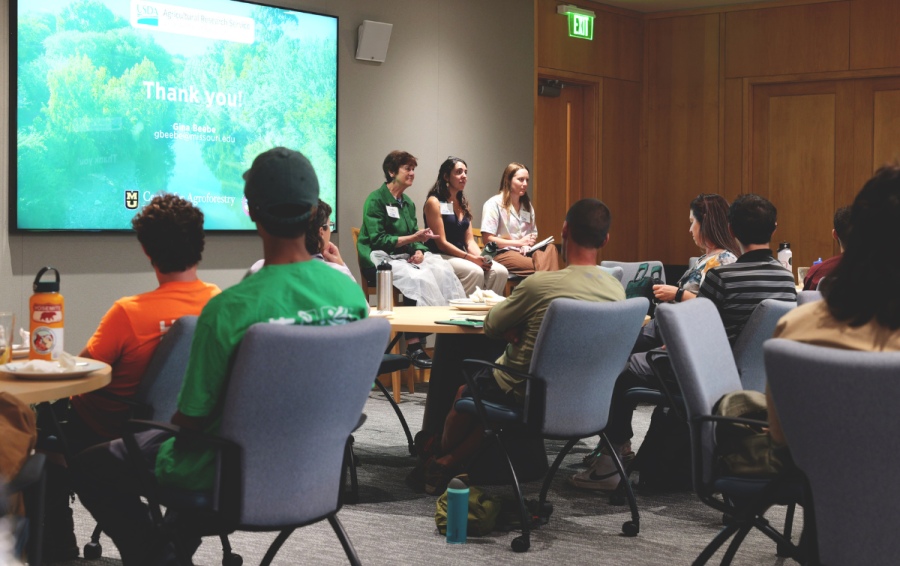
Next, the audience heard from Gina Beebe, Research and Education Specialist at the Mizzou Center for Agroforestry. Beebe presented research-based best practices to design and manage agroforestry and riparian restoration projects to include edible plant species.
"Successional planning has to be a part of the management of your land, especially when it comes to invasive species," says Beebe. "Think in decades, not years."
She walked through diagrams showing riparian zones typical of our region -- forests that border river systems like the Blue River, which is undergoing a vast riparian restoration with help from the Heartland Conservation Alliance and other local partners. Zone 1 represented unmanaged forests that act as a stabilization barrier to the river bank. Their shade provides stream temperature regulation, but the movement of the current and saturation of the surrounding earth make this zone harder to intentionally grow plants that don't appear on their own, naturally. Here you will find medicinal willows, cottonwoods, sycamores and prairie cordgrass.
Zone 2 was where Beebe got to dive into the diverse trees and shrubs yielding edible fruits, nuts, berries and spices. This zone features canopy complexity and a more vertical structure. Here you can grow paw paw, hazelnut, serviceberry, elderberry, pecans, nettles, persimmon and more! "I like the sochan or 'goldenglow'," says Beebe. "It's a nutritious coneflower, and you can use it as a kale alternative."
Lastly, she discussed Zone 3 -- the lowlands -- where you can maintain woody florals and forbs: things that don't tolerate wet roots as well. These zones are on the edges of riparian forests and provide a buffer to cleared and active lands. In addition to lots of pollinator attractors like milkweed, edible currants, raspberries, mountain mint and anise hyssop thrive here.
The workshop ended with a Q&A session moderated by MARC Water Quality program director Natalie Unruh.