Planning Sustainable Places (PSP) 2027 Call for Projects

Beginning May 4, MARC will seek applications for studies. 

The program will help fund transportation-focused planning and projects that: 

  • Advance detailed local activity center studies.
  • Advance small area plans.
  • Support localized public engagement.

Funds awarded will help support and position projects to move from planning to implementation.

The PSP program continues the work of the Creating Sustainable Places initiative and Connected KC 2050, the region’s long-range plan. The program promotes concepts consistent with sustainable communities and the advancement of site-specific and project-specific activities within the centers and corridors planning framework.

This round of funding builds on previous ground rules for the competitive regional solicitation, including:

  • Categories — applications must be categorized as either:
    1. Sustainable places studies.
    2. Project development.
  • Program emphasis — all studies must emphasize transportation and may include integrating intermodal transportation options, redevelopment and sustainable land-use patterns, social equity and environmental stewardship through targeted planning, and meaningful public engagement.
  • Projects require a minimum 20% local cash match.
  • All nine counties within MARC’s metropolitan planning boundary are now eligible to apply for PSP funds. Priority status will be given to planning projects conducted in activity centers within the region’s redevelopment area and areas that include multiple opportunities for sustainable development.
  • The maximum grant award is $150,000. There is no minimum grant award amount.
  • Work should begin in early 2027 and be completed by the second quarter of 2028.

Funding

Available funding total: $1,3000,000

  • $800,000 – Kansas Surface Transportation Program
  • $500,000 – Missouri Surface Transportation Program
Layer Title
Schedule
Table
Date Activity
May 4, 2026 Call for studies opens.
May 20, 2026 Call for studies pre-application workshop at MARC offices and virtually via Zoom.
June 22, 2026 Project submission deadline at 4 p.m.
July 1-22, 2026 Project submission public comment period.
July 2026 MARC staff technical analysis and scoring.
July-September 2026 Sustainable Places Policy Committee (SPPC) evaluation and prioritization.
September 2026 TTPC and MARC Board approval.

Office Hours

Office hours are available on the following dates and will be held on virtually on Microsoft Teams.

  • May 13, 10 a.m. - Register
  • May 28, 4 p.m. - Register
  • June 16, 2 p.m. - Register

Project portal

View projects and comments

The 2027 Call for Studies will open on May 4, 2026, and close at 4 p.m. on June 22, 2026.

Guidebook

Information about project eligibility, the programming process, evaluation criteria and other important considerations will be available in the 2027 submission guidebook. 

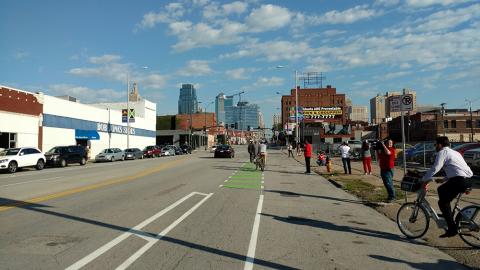
People riding bikes on bike lane along Grand Avenue

MARC Transportation plans and studies

Relevant plans include the Regional Pedestrian Policy Plan, Regional Plan for Sustainable Development, Regional Bikeway Plan and the Unified Planning Work Program.

Freight trains heading off into the sunset

Connected KC 2050

As the metropolitan transportation plan for the Kansas City region, Connected KC 2050 serves as a blueprint for managing the transportation system for the next 30 years.

Green Infrastructure Project at the Shawnee Mission School District

Environment plans and studies

MARC has several environment plans and studies, including MetroGreen, Stormwater Best Management Practices, Natural Resources Inventory, Green Infrastructure Framework and the Regional Climate Action Plan.

workforce-housing-apartment-complex

Housing and community resources

MARC's related housing and community resources include the Communities for All Ages program and Housing work.

Best practices

MARC is prepared to provide assistance in the use of tools, however, the level of support may be affected by the demand for assistance. The resources included below are considered best practices in planning and are intended to improve how communities plan for and make decisions about growth and development.

Scenario Planning

Scenario planning is an analytical tool that offers a framework to develop a shared future vision for a community or project. The process typically involves creating two or more land use and development strategies and then analyzing the health, transportation, environmental, economic, and land-use impacts of each strategy. A successful scenario planning experience actively involves the public, including underrepresented communities, the local business community and elected officials to not only incorporate their feedback but also educate about the interplay of land use and development strategies and impacts on the community. Scenario planning tools can take the form of spreadsheets, GIS-based tools or a combination of spreadsheet and GIS functionality to offer more sophisticated modeling.

Data Indicators

Indicators provide a means to define outcomes and track community progress. By defining community characteristics, measurement of change is possible. A community should determine which characteristics should be monitored and periodically reviewed to determine the achievement of the desired change. Indicators may include a community’s population, income, transportation resources, education levels, employment or air quality to identify critical needs, initiate action and measure progress over time. Sources for indicators include the U.S. Census Bureau, local government agencies, the Center for Disease Control and more.

Environmental Data

MARC provides a free Natural Resources Inventory for the region. A variety of environmental data has been collected to allow communities to better understand the condition and location of natural resources. The data may document the presence of land cover, the location of floodplains, hydrography, topography and types of soil. It can be especially useful in assessing potential environmental impacts from specific developments. Sources of environmental data include the Natural Resources Conservation Service, the U.S. Geological Survey and the Environmental Protection Agency.

Visualization

The combination of images depicting local development through digital manipulation allows communities to create, refine and clearly communicate the local vision of potential development and redevelopment. It creates images that foster discussion and communication between jurisdictions, developers and the public. Examples can be as simple as illustrating street improvements — such as improved sidewalks or bike lanes — or can be as extensive as façade upgrades or infill development. MARC can assist a community in creating visualizations of development plans and proposed projects.

Market Information

Market research information provides a snapshot of business or consumer activities for a given geographic area. The information helps to ground community plans by better understanding what the market will support. Examples of data include retail sales, prevailing commercial lease rates, residential rental rates and market demand projections. Providers can be varied but some national resources include ESRI’s Community Analyst, Dun & Bradstreet, the Bureau of Labor Statistics’ Consumer Expenditure Surveys, or lifestyle segmentation systems such as ESRI’s Tapestry, Claritas’ Prizm or Experian’s Mosaic. MARC has access to many of these resources and can assist your community in developing a market assessment for a plan or project.

False